
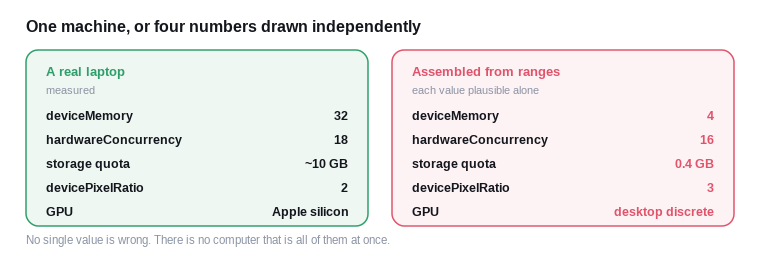
Four numbers, read in four lines, from four different subsystems:
navigator.deviceMemory            // 32
navigator.hardwareConcurrency     // 18
(await navigator.storage.estimate()).quota   // ~10 GB
devicePixelRatio                  // 2
Plus the GPU string, the screen size, and whatever mediaDevices says about cameras and microphones. Individually each is low entropy: memory is a small set of values, core counts cluster on a handful of numbers, quota is a rounded tier. Nobody is identified by their core count.
Together they describe a machine, and machines are not assembled from independent draws. A workstation with eighteen cores does not have four gigabytes of memory. A device reporting a mobile GPU does not have a 1512-pixel-wide screen at dpr 2 and a terabyte of free disk. The signal is not any of the numbers. It is whether they are the same computer.
Where each number comes from
The reason they drift apart in a persona is that no single override touches them all.
deviceMemory is a coarse report of physical RAM, quantised to powers of two. hardwareConcurrency is the logical processor count. storage.estimate().quota is derived from free disk space and origin quota policy, and it moves as the disk fills. devicePixelRatio and the screen dimensions come from display information. The GPU strings come from the driver. Camera and microphone counts come from the media enumeration layer, without labels unless permission was granted.
Six subsystems. A persona configuration typically covers two or three of them, and the ones it misses report the host.
What coherence looks like
The rules are not exact, but the tiers are real, and a detector does not need precision to catch an assembled machine.
| claimed device | memory | cores | GPU | dpr | screen |
|---|---|---|---|---|---|
| current laptop | 8 to 32 | 8 to 24 | integrated or Apple silicon | 2 | 1440 to 1728 logical |
| budget desktop | 4 to 8 | 4 to 8 | integrated | 1 | 1920×1080 |
| workstation | 32 to 128 | 16 to 64 | discrete | 1 or 2 | large |
| current phone | 4 to 12 | 6 to 8 | Adreno or Mali | 2.6 to 3.5 | 360 to 430 logical |
| container | 2 to 8 | 2 to 8 | software renderer | 1 | 1920×1080, no camera |
The combinations that fire are the ones that cross rows. Sixteen cores with four gigabytes of memory. A discrete workstation GPU with a phone-sized screen. A phone-class dpr of 3 with a desktop GPU string. Eight gigabytes of memory and a quota measured in tens of megabytes, which describes a disk that is full - possible, and unusual enough to be worth a point.
The container row is the interesting one for bot detection, because it is coherent in itself and distinctive as a whole. Software renderer, no camera, no microphone, dpr 1, exactly 1920×1080, a modest even core count. Nothing there contradicts anything. It is simply a recognisable kind of machine, and recognising it does not require finding a lie.
Spec caps rot, and checks that hardcode them rot with them
Here is a live example of why this class of check needs care.
deviceMemory has, for most of its history, been capped at 8: the specification describes clamping the reported value to an upper bound so that high-memory machines cannot be singled out. A great deal of detection code has if (deviceMemory > 8) suspicious written into it on that basis.
The machine measured for this post reports 32, on a stock Chrome 151.
Whatever the reason - a raised bound, a changed policy - the practical lesson is the same, and it is not about this one value. A check built on “the specification caps this at N” is a check with an expiry date, and it fails in the worst direction: it starts flagging honest current browsers as liars, quietly, some months after the change ships, in a scanner that nobody has looked at since it was written.
The durable version of the same check does not encode the cap. It asks whether the value is one of the shapes the API produces at all - a power of two, in the range these APIs use - and whether it sits in the same tier as the core count, the GPU and the screen. That question does not go stale when a bound moves.
The general form is worth stating, because this site’s own checks have to obey it: prefer relationships between measurements over constants about the world. Relationships are maintained by the machine. Constants are maintained by you.
Storage quota, specifically
storage.estimate() returns quota and usage, and both are useful in different ways.
quota scales with available disk, so it is a rough disk-tier signal. Rounded to gigabytes it carries very little entropy, which is what makes it safe to collect and enough to catch the extremes: a quota under a gigabyte on a machine claiming to be somebody’s laptop is a small container or a full disk.
usage is per-origin and effectively zero for a fresh profile. There is a subtler signal in it for a site that stores something: a browser that returns to a site with usage of zero, having been given data to store on a previous visit, has arrived in a fresh profile every time. That is not a fingerprint, it is a session-continuity observation, and it separates a returning human from a fleet of clean profiles better than most fingerprint dimensions do.
The linkability side of the same coin
There is a reason personas fabricate hardware numbers rather than passing the host’s through, and it is not perversity.
Pass everything through honestly, and every profile on one machine reports the same memory, the same core count, the same GPU, the same screen and the same quota tier. That is a strong joint key. A site does not need to identify the machine to notice that forty accounts share one.
So the choice on this dimension is the field’s usual one: fabricate and risk incoherence, or tell the truth and accept correlation. What makes hardware slightly friendlier than fonts or GPUs is that the honest variation within a plausible tier is real. Core counts differ across a fleet of similar laptops. Memory configurations differ. Screen sizes differ. A set of personas drawn from real machines of one class stays coherent while not being identical, which is a better place to be than either extreme.
Drawing them independently from plausible ranges is what produces the eighteen-core machine with four gigabytes of memory, and that is the failure this check exists to find.