
This blog has spent twenty-odd posts obsessing over fingerprint consistency: deterministic canvas noise, the WebGPU triad, offsetWidth font geometry, JA4H, the dpr==1 hash. All of it real. All of it necessary. So let me say the quiet part plainly, on a blog that sits right next to a fingerprint scanner. Getting all of that perfect is the price of admission. It is not the thing that wins. The single strongest signal in the first-hand community record cuts against the entire “which anti-detect browser is best” question. The brand is not what gets your accounts banned.
The counter-thesis nobody selling software wants to print
Read enough r/webscraping threads and BlackHatWorld post-mortems from operators who actually run accounts at scale, and one view keeps surfacing from the people with the most scar tissue. Switching anti-detect browsers does not fix bans. Here is a representative BlackHatWorld sentiment, paraphrased from a long-time operator:
I’ve never once seen a case of getting chain-banned inside one anti-detect browser and then having it fixed by switching to a different one. When that happens, it’s a proxy problem, not a browser problem.
That is not a fringe opinion. It’s the modal opinion among people who don’t have a referral link in their signature. And the corollary is uncomfortable for a whole industry. Past a competence baseline, the marginal ban-survival you buy by upgrading from a decent browser to a “premium” one rounds to zero, because the browser was never the binding constraint.
What actually decides the outcome
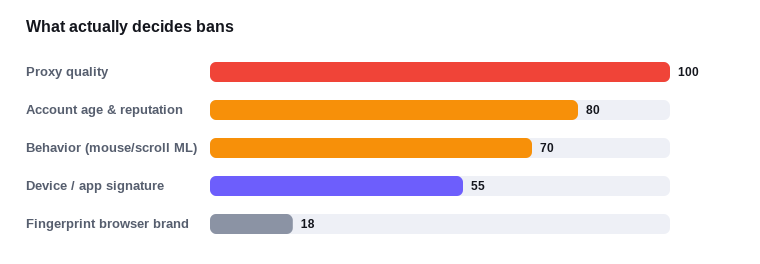
The variables that determine whether an account or a scrape survives, roughly in order of impact:
| What decides outcomes | Why it dominates | What people obsess over instead |
|---|---|---|
| Proxy quality | Datacenter IPs get 5 to 12% success on airline/ticketing targets; residential/mobile is a different universe. IP reputation is checked before your JS runs. | Which fingerprint browser has the “best” canvas noise |
| Account age & reputation | On LinkedIn, only 2-year-old+ accounts reliably survive; fresh accounts die regardless of tooling. | Fresh accounts on a shiny new profile |
| Behavior | Mouse/scroll/keystroke ML is its own axis. On StockX you can pass every fingerprint check and still be blocked by mouse-movement analysis alone. | Static fingerprint values |
| Device / app signature (mobile) | TikTok/Instagram lean on app-level signatures and device attestation the browser can’t touch. | Desktop browser profiles |
| Fingerprint consistency | Table stakes. Necessary to clear the door; not a differentiator once you’re at zero-lies. | Everything |
Look at where the fingerprint sits. It’s real, and a broken one gets you caught, but it’s the floor rather than the ceiling. The people who lose accounts overwhelmingly lose them one row higher than the browser: on the proxy, the account, or the behavior.
Mobile-first social is where the illusion dies fastest
Want the cleanest demonstration that the browser brand doesn’t decide the fight? Look at mobile-first platforms, where fingerprint browsers essentially cannot win no matter which one you pick.
- TikTok protects its API with app signatures (the
X-Argus/X-Gorgon/X-Ladonfamily, Protobuf plus SM3 hashing) that a desktop browser never produces. First-hand reports are blunt: the platform can “detect you are using an antidetect browser (all Selenium/Chromium based),” and accounts get shadowbanned for exactly that. Octo Browser doesn’t even offer mobile profiles. That’s a hard structural limitation, not a tuning gap. - Instagram / Meta runs device fingerprinting, machine IDs and checkpoints. As one operator put it: “It’s not an anti-detect browser issue, it’s Instagram, advanced detection.” Kameleo on premium static residential still ends in bans and selfie verification.
- LinkedIn (PerimeterX/HUMAN plus Akamai) surfaces “their system sees something deeper,” and no anti-detect browser gets named as a reliable survivor. Only aged accounts do.
- X / Twitter (Arkose FunCaptcha plus TLS/JA3 plus behavior): one first-hand report describes premium dynamic US residential IPs plus GoLogin plus two-year-old accounts, all suspended at scale.
In every one of these, the operators had a competent fingerprint browser. It wasn’t enough, because the wall stood somewhere the browser doesn’t reach.
The defender’s view: you’re all one class anyway
Here is the part that should reframe the whole shopping decision. From the detection side, the distinctions anti-detect vendors market to you barely exist. The ex-DataDome research VP Antoine Vastel and the niespodd fingerprinting notes converge on treating every commercial anti-detect browser as a single detectable class: a real Chrome running a fake fingerprint. CDP and automation detection, in this framing, target the underlying automation itself, explicitly “including those that try to hide via anti-detection features.” Custom Chromium engines are observed to trail the official build by something like ten versions, and their AudioContext/WebGL overrides “can be detected by custom JS.”
If that’s the adversary’s mental model, then choosing browser A over browser B is rearranging deck chairs inside one bucket the detector already boxed off. The way out of the box is not a better-marketed override. It’s having no overrides that betray themselves ([native code], engine-level), and, more importantly for bans, not tripping the axes that put you in the box to begin with: automation protocol, network layer, IP, behavior.
The reviews are poisoned
Compounding all of this: the anti-detect discourse is one of the most astroturfed corners of the internet. One BlackHatWorld user documented that the accounts loudly recommending a popular vendor were freshly created accounts mass-posting; another vendor was described as having been “shilled on BHW for weeks.” Every vendor’s own X-vs-Y comparison table declares that vendor the winner, and they contradict each other. Even the test sites are entangled. Pixelscan is promoted by Multilogin/GoLogin, Iphey is tied to GoLogin, BrowserScan promotes Hidemyacc, so “Browser X passes Site Y” is not neutral when X and Y share a parent. The one independent controlled comparison that exists inverted the marketing order outright. Treat online recommendations as low-signal by default.
Where the browser genuinely matters (don’t overcorrect)
None of this means the browser is irrelevant. Claiming that would be its own kind of dishonesty. A weak setup fails on its own merits. A Reddit r/browsers commenter’s first-hand note captures the floor:
Brave with fingerprinting turned off gets flagged for “inconsistent fingerprints” and BitBrowser leaks WebRTC, you need something like GoLogin or Dolphin’s free tier to actually clear the consistency bar.
That’s exactly right, and it’s the whole point of the fingerprint work. You do need a competent browser to pass the consistency and lie-detection door, the CreepJS-class checks this blog keeps dissecting. What you don’t need is to keep paying up the brand ladder expecting the next tier to save accounts that are dying on the proxy. Necessary, but not sufficient, and the “necessary” part has a ceiling you hit fast.
The honest close
Get your fingerprint to zero lies and move on. That’s a solved-enough problem: deterministic noise, one identity across every realm, a believable modern persona, native functions that really are native. Verify it once against an independent yardstick, then stop tuning it.
Spend your actual attention where the bans actually come from: the proxy pool, the age and warmth of the accounts, the plausibility of the behavior and, for the hardest walls, the network layer your JavaScript can’t even see. A green CreepJS score is a comforting thing to stare at. Don’t let it lull you into thinking the fight is only fingerprint-deep. It almost never is.