
Most of the checks on this site look like separate discoveries. Font widths collapsing onto one number. Mobile texture formats under a desktop GPU string. A notification constructor that throws on one platform and not another. A window larger than the screen it claims to be on.
They are one idea, applied to different surfaces.
Every fingerprint dimension has two layers. There is a label: a string, a list, a boolean, a number the browser reports because something told it to. And there is machinery: a rasteriser, a driver, a compiler, an allocator, a window server, which produces observable output as a side effect of doing its actual job.
Labels are cheap to rewrite. That is what they are - values in a struct. Machinery is expensive to change, because changing it means changing what the computer does.
Ask the machinery.
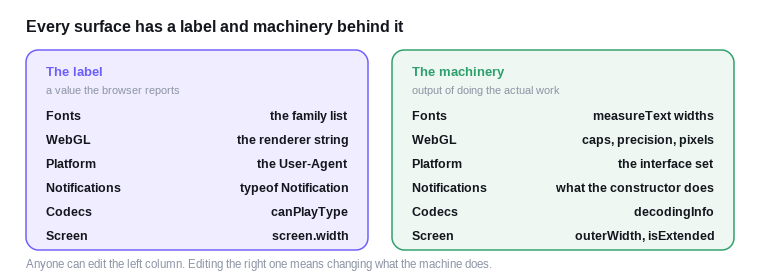
The table
| surface | the label | the machinery |
|---|---|---|
| Fonts | which families enumerate | what measureText returns for them |
| WebGL | UNMASKED_RENDERER_WEBGL |
numeric caps, precision triples, extension list, rendered pixels |
| WebGPU | adapter.info.vendor |
the feature list and the numeric limits |
| Canvas | nothing to label | the pixels a draw produces |
| Codecs | canPlayType strings |
whether a decoder initialises, and decodingInfo |
| Platform | the User-Agent, navigator.platform |
which interfaces the binary exposes |
| Notifications | typeof Notification |
what the constructor does when called |
| Screen | screen.width |
outerWidth, screenX, availTop, isExtended |
| Timezone | Intl…timeZone |
the January and July offsets, the DST transition |
| Permissions | Notification.permission |
permissions.query() for the same name |
| Emoji | the font name you request | the pixels the host’s emoji font draws |
| Fonts, again | a metric-compatible substitute’s widths | its fontBoundingBox and baselines |
Read it as a generator rather than a list. Given any surface, the question to ask is: what does this browser have to compute in order to answer, and can I make it compute instead of report?
Why it works
Three properties make the machinery side structurally hard to fake, and they are worth naming because they explain why this asymmetry is durable rather than a temporary state of the art.
It is downstream of real work. The width of a string is produced by a shaping engine walking a font file. To change it you need a different font file. The extension list comes from a driver enumerating hardware capabilities. To change it you need to intercept a lower layer than the one your persona configuration lives in, and each such interception is a patch to write, rebase and maintain.
It is high-dimensional. A renderer string is one value. The table under it is forty numbers, twelve precision triples and thirty-odd extension names. A persona can fabricate one value convincingly; fabricating a hundred correlated values means fabricating the machine that would have produced them. Which is why the approach that actually works is capture and replay of a whole surface from a real device, rather than field-by-field invention.
It is self-consistent by construction. Any two outputs of one piece of machinery agree because they came from the same machinery. The same is not true of two fields in a config file. Every additional place the same fact is observable is another chance for the config to disagree with itself, and the number of such places only grows as the platform adds APIs.
The corollary: absence is not silence
There is a failure mode this rule exposes that is worth calling out on its own, because it makes masked browsers score better than honest ones.
Enumeration checks work by looking for evidence. The font set says macOS, the User-Agent says Windows, contradiction. A mask that removes the evidence - subtracts the host’s fonts from the enumerable set - leaves the check with nothing to compare, and a check with nothing to compare usually returns “cannot evaluate” rather than “suspicious”. The browser that erased the evidence passes.
The measurement version does not have that hole. Removing macOS fonts from an enumerable list does nothing to the fact that the Windows names in that list have no metrics behind them. You cannot subtract your way out of a question whose answer is produced rather than reported.
The design rule for a scanner follows: when a check cannot evaluate, record why. “No macOS evidence found” and “no evidence of any OS found” are very different states, and a scoring system that collapses both to a skipped check has a blind spot exactly where the sophisticated tools live.
Applying it to something new
The rule is a generator, so here it is generating.
Speech synthesis. The label is the voice list. The machinery is the audio a voice produces, and the language of the default voice, which comes from the operating system’s installed voices rather than from the browser’s language setting.
Media capabilities. The label is canPlayType, which returns "probably" or "" from a static table. The machinery is MediaCapabilities.decodingInfo, which reports whether playback would be smooth and power-efficient, and those two booleans are answers about the hardware decoder that is actually present.
Layout. The label is any CSS property you can read back. The machinery is where the boxes land: subpixel geometry from getBoundingClientRect, line breaking, and the height of an inline box at line-height: normal, which encodes the font’s own ascent and descent in a completely different API from measureText.
Compression and decoding paths. The label is a MIME type in a support list. The machinery is whether a deliberately malformed input produces the specific error the real decoder produces.
None of those needs a new insight. They need the same question asked in a new place.
What it costs the other side
It would be dishonest to present this as unbeatable. The rule describes an asymmetry in cost, not an impossibility, and the cost is payable.
Capture-and-replay of a whole surface defeats the WebGL version. Shipping real font files defeats the font version, entirely and legitimately, for any platform whose fonts are openly licensed. Building an actual Android binary defeats the interface census. Every one of those is a real answer, and the good implementations are moving toward all of them.
What the rule does is set the price. It converts “edit a string” into “acquire a real device, capture its whole surface, and serve it coherently”, or into “build the platform you claim to be”. Those are engineering projects with ongoing maintenance, not configuration options, and they are precisely the projects that separate a browser that survives a serious detector from one that survives a scanner.
The point of a detection tool is to make that the only path. Not to be unbeatable, but to be unbeatable cheaply - so that the only way through is to actually be the thing you say you are, on every layer that a page can reach.