Every anti-detect vendor publishes a comparison table, and in every one of them the vendor wins. Multilogin’s table crowns Multilogin. Kameleo’s puts Kameleo first, GoLogin’s puts GoLogin first. They cannot all be right, and none of them is reproducible. So where does the actual evidence live? There is a single independent controlled comparison that inverts the marketing order. There are also open-source engine benchmarks, the only place a reproducible “only a few pass” result exists. Both come with caveats you need to hold onto, because they contradict each other too.
The marketing is circular by construction
Start with the thing that makes vendor benchmarks worthless. They are self-refereed. Multilogin’s own numbers claim a 94% SNKRS success rate and rate every rival under 65%, calling GoLogin “60%, too low” and putting Octo, AdsPower and Dolphin all at “<65%”. Kameleo’s own table shows Playwright+Kameleo passing fingerprint.com, Iphey, Pixelscan, BrowserScan, CreepJS and Turnstile clean, and the blog copy calls it “the only browser that passes BrowserScan.” Both cannot be true. Neither has been reproduced by anyone who does not sell the product.
The bias is structural. A vendorA-vs-vendorB post exists to convert a search query into a signup. The test conditions are never published in reproducible form, and the one browser configured by an expert who wants it to win is the author’s own. The correct prior for any first-party “X beats Y” table is zero evidentiary weight. Treat all of it as marketing, including the tables that happen to agree with your existing preference.
The one independent controlled comparison
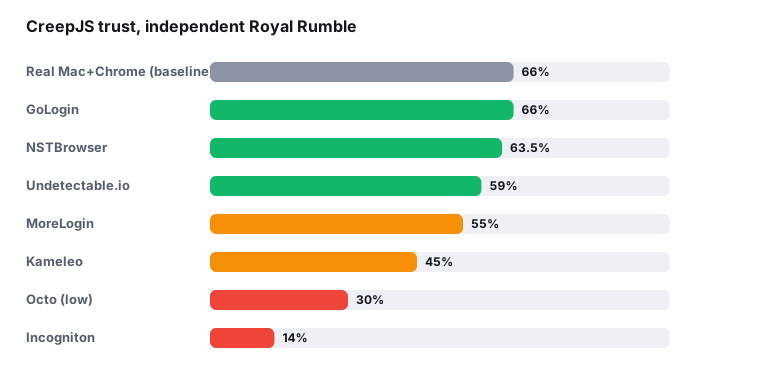
The closest thing to a controlled experiment comes from The Web Scraping Club’s “Anti-Detect Browser Royal Rumble”, run by an independent practitioner who does not sell an anti-detect browser. Seven browsers, a 260-point scale combining CreepJS trust score, BrowserScan authenticity and a WebRTC check, each run once through a single IP.
One framing detail gets missed a lot, and it changes how you read the whole table. A real, unmodified Mac + Chrome baseline scores only ~66% CreepJS trust (with 100% BrowserScan, 226 points total). CreepJS is deliberately punishing, and a genuine browser does not score 100%. What you want to read is the relative gap from that baseline, not the absolute percentage. A browser at 63% is essentially indistinguishable from a real machine on this axis. A browser at 14% is screaming.
| Rank | Browser | CreepJS trust | BrowserScan | Total (/260) |
|---|---|---|---|---|
| base | Baseline (real Mac + Chrome) | 66% | 100% | 226 |
| 1 | GoLogin | ~66% (just below baseline) | 100% | 223 |
| 2 | NSTBrowser | 63.5% | 95% | 218 |
| 3 | Undetectable.io | 59% | 100% | 209 |
| 4 | MoreLogin | ~55% | ~90% | 198 |
| 5 | Kameleo | 45% | 90% | 175 |
| 6 | Octo Browser | “particularly low” | 100% | 164 |
| 7 | Incogniton | 14% | 85% | 139 |
The two browsers marketed most aggressively as premium, Octo and Kameleo, landed mid-to-low on CreepJS trust. The “mid-market” GoLogin topped the chart and sat within a point or two of a real machine. The marketing order and the measured order are not the same list.
The browsers sold as premium scored mid-pack on CreepJS trust, while a cheaper mid-market option came out on top. The marketing order and the measured order are not the same list.
The Web Scraping Club, independent
The caveats matter as much as the ranking. It is seven browsers, one IP, one run each, and it leaves out Multilogin, AdsPower and Dolphin entirely, so the field is incomplete. The author is explicit that CreepJS is an educational project. A high trust score means your fingerprint is internally coherent and does not obviously lie. It does not mean you will survive a real business site’s behavioral and network-layer defenses. Passing CreepJS is necessary, not sufficient. One first-hand corroboration exists at the low end. A BlackHatWorld user reported Dolphin Anty failing the Hardware section of iphey.com where GoLogin passes, which fits GoLogin’s placement, though it is a single anecdote rather than a benchmark.
There is also a conflict-of-interest wrinkle in the test sites themselves. Pixelscan is promoted by Multilogin and GoLogin, Iphey is tied to GoLogin, and BrowserScan promotes Hidemyacc. A browser “passing” a site it is commercially affiliated with is not neutral evidence. CreepJS survives this critique, since it is Abraham Juliot’s independent open-source project with no vendor tie, which is exactly why it carries the weight here. The independent hard yardsticks worth trusting: CreepJS, Incolumitas, Antoine Vastel’s sites (deviceandbrowserinfo.com, fingerprint-scan.com), tls.peet.ws, EFF Cover Your Tracks, AmIUnique and nowsecure.nl.
Where reproducible “only a few pass” actually lives
The clean, reproducible evidence sits somewhere else entirely, at the open-source automation-engine layer: Patchright, nodriver, Camoufox, curl_cffi against vanilla Playwright and Selenium. These benchmarks publish per-target results and can be re-run, and they converge on one finding. What separates tools against hard walls is the automation-protocol fingerprint, meaning how you drive the browser, not what the browser claims about its canvas or GPU.
Ian Paterson’s benchmark (May 2026) ran 7 tools against 31 real Cloudflare-protected targets, three rounds, 651 total verdicts:
| Tool | OK | Gated | Blocked |
|---|---|---|---|
| nodriver (Chrome 148, direct CDP) | 28 | 3 | 0 |
| CloakBrowser | 26 | 3 | 2 |
| curl_cffi (chrome) | 26 | 3 | 2 |
| Patchright (channel=chrome) | 25 | 3 | 3 |
| Camoufox (Firefox 135) | 25 | 3 | 3 |
| Vanilla Playwright | 24 | 2 | 5 |
| rebrowser-playwright | 24 | 2 | 5 |
nodriver was the only tool with zero hard blocks. Vanilla Playwright and the “stealth” rebrowser-playwright fork scored identically here. Against this Cloudflare set the stealth patches bought nothing measurable, and the differentiator was the driving method rather than the cosmetic patches layered on top.
A second data point, techinz/browsers-benchmark (May 2026), publishes per-target JSON. Against Akamai (the Mr Porter target), of 23 engines only 3 passed: Patchright, CloakBrowser (headed) and playwright-firefox (headless). nodriver, zendriver, Camoufox, AdsPower and seleniumbase all failed that specific wall. This is the genuine article, a reproducible per-target result showing that against the hardest bot-management stacks the passing set collapses to a handful.
The methodology warning: the benchmarks contradict each other
Here is the part that should stop you from quoting any single result as gospel. The two open-source benchmarks disagree about the same tool on the same vendor.
- techinz, using rotating proxies, found Camoufox passing Cloudflare essentially 100%.
- Ian Paterson, using a single IP, found Camoufox failing on the Cloudflare set and only nodriver passing cleanly.
- A vendor blog (selling a bypass service) reported the opposite again, with nodriver blocked by Cloudflare Enterprise and Camoufox the one that passed.
You cannot reconcile them by picking the “right” one, because they measure different things: proxy quality, single-IP versus rotating, headed versus headless, and the target’s mitigation state on the day it ran. The Akamai and Kasada walls show the same instability. Camoufox-headful failed a Kasada target where Camoufox-headless passed, and zendriver failed a target in both modes that others cleared.
The operational lesson is blunt. There is no “tool X always passes site Y.” Any “only X passes” claim, including the ones in this very post, is a snapshot bound to a proxy configuration, a browser mode and a day. A benchmark that hands you a clean winner without telling you the proxy setup and the run date is not telling you enough to act on. Pair every “only X passes” with the contrary evidence, because the contrary evidence exists.
There is a deeper structural reason for the instability, and the defensive side states it plainly. Antoine Vastel (formerly research VP at DataDome) and the niespodd fingerprinting notes argue that CDP-based detection targets the underlying automation technology itself, including the tools built to hide it, and that custom-Chromium anti-detect browsers trail the official kernel by several versions, leaving AudioContext and WebGL override artifacts that custom JS can surface. In that framing every commercial anti-detect browser is one detectable class (“real Chrome, faked fingerprint”), and the automation layer is where the real signal lives. That fits the engine benchmarks, which put the whole differentiation on how you drive rather than on the fingerprint the product advertises.
What to actually do with this
Three things follow directly from the evidence.
First, discard vendor comparison tables completely. Do not merely discount them, discard them. A first-party “we beat them” table has no evidentiary weight regardless of how detailed it looks. The moment a comparison is published by a party that sells one of the entries, it is marketing.
Second, when you evaluate a browser, run it yourself against the independent yardsticks and read the relative gap from a real machine rather than the absolute score. CreepJS first, then a real Cloudflare wall like nowsecure.nl. Ignore Pixelscan/Iphey/BrowserScan “passes” for browsers affiliated with those sites. Clearing every fingerprint test still tells you nothing about whether a business site bans you. That is decided by proxy quality, account age and behavior, none of which a fingerprint benchmark measures.
Third, if reproducibility is what you need, the open-source engine benchmarks are the only tier that offers it, though you should treat each result as a snapshot pinned to its proxy setup and run date. nodriver looking strongest on a single-IP Cloudflare set in May 2026 is a real finding. It is not a law of nature, and the techinz numbers on a different proxy regime prove it.
Takeaway
The marketing order and the measured order are different lists. The one independent controlled comparison put the “premium” browsers mid-pack and a mid-market one on top. The reproducible “only a few pass the hard walls” evidence lives in open-source engine benchmarks that measure how you drive rather than what you claim, and even those contradict each other the moment the proxy setup changes. Trust the yardstick you can re-run, read the relative gap, and distrust any clean winner that arrives without its conditions attached.